You already know your basement has a moisture problem. The question now is how to fix it. If you’ve started researching, you’ve probably seen two approaches come up over and over: interior waterproofing and exterior waterproofing. Both work, but they solve different problems in different ways, and choosing the wrong one can mean spending money on a solution that doesn’t actually address what’s happening in your home. This guide will help you figure out which approach makes sense for your situation, especially if you’re in the Charlotte or Charleston area.
The Quick Answer: It Depends on Where the Water Is Coming From
Here’s the simplest way to think about it:
If water is seeping through your basement walls, pooling on the floor, or showing up as condensation and dampness inside the space, interior waterproofing is usually the right call. It manages the water that’s already making its way in.
If water is hitting your foundation from the outside because there’s no membrane, the grading is wrong, or exterior drainage has completely failed, exterior waterproofing may be needed. It stops the water before it ever reaches the wall.
For most existing homes in North Carolina and South Carolina, interior solutions are what actually get installed. Here’s why.
When Interior Waterproofing Makes Sense
Interior waterproofing is the most common approach for homes that are already built, and for good reason. It’s effective, less disruptive, and doesn’t require digging up your yard or landscaping.
You’re likely a candidate for interior waterproofing if:
- You see water seeping along the base of walls or through floor joints after heavy rain
- Your basement walls feel damp or show white mineral deposits (efflorescence)
- You’re dealing with persistent humidity, condensation on pipes, or musty odors
- Hydrostatic pressure from Charlotte’s clay soil is pushing moisture up through the slab
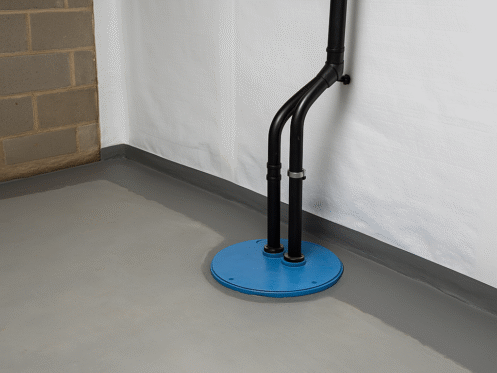
A typical interior system includes a perimeter drain installed along the base of the wall, a sump pump to actively remove collected water, and a dehumidifier to manage residual humidity. The work is done from inside the basement, usually takes one to two days, and doesn’t touch your exterior landscaping or driveway.
When Exterior Waterproofing Makes Sense
Exterior waterproofing is a bigger job. It involves excavating the soil around your foundation, applying a waterproof membrane directly to the exterior wall, and installing drainage at the footing level to redirect water away before it ever reaches the basement.
This approach makes sense when:
- The foundation wall itself is deteriorating or was never waterproofed during construction
- You’re building a new home or already doing major excavation for another reason
- Grading around the house is severely sloped toward the foundation with no practical way to fix it from the surface
- Interior solutions have been tried and the water source is clearly external
Exterior waterproofing is highly effective, but it’s also significantly more expensive and invasive. It requires heavy equipment, affects landscaping, and takes longer to complete.
What Most Charlotte & Charleston Homeowners End Up Choosing
In our experience, the vast majority of existing homes we work on benefit most from interior waterproofing. There are a few reasons for that.
In Charlotte, the red clay soil holds water and creates hydrostatic pressure that pushes moisture in through floor joints, wall-floor connections, and small cracks. Interior drainage systems are specifically designed to handle this type of water entry. Exterior work wouldn’t necessarily stop hydrostatic pressure from below.
In Charleston, the high water table means groundwater is always present near your foundation. A sump pump and interior drain system keeps that water moving out before it becomes a problem. Without active water removal, Charleston basements stay damp no matter what’s on the outside of the wall.
Exterior waterproofing is less common for retrofit situations because the cost is higher, the disruption is greater, and in most cases, a well-designed interior system solves the problem without needing to excavate. Some homes do need both, but it’s rarer than some contractors make it seem.
Questions To Ask Before You Decide
Before committing to either approach, think through these questions:
- Where exactly is the water showing up? Along the floor, through the walls, or around windows?
- Is this a new problem that started after a specific event, or has it been slowly building?
- Has anyone done drainage or grading work on the exterior before?
- Is the foundation wall itself visibly cracking, crumbling, or bowing from outside?
A good contractor will walk through these with you during an inspection and explain why they’re recommending one approach over another. If someone quotes you a full exterior dig without even looking at where the water is entering from inside, get a second opinion.
Frequently Asked Questions
Is interior waterproofing a permanent fix?
When installed correctly, yes. Interior drainage systems and sump pumps are designed for the long haul. Sump pumps may need replacement after 7 to 10 years, but the drain system itself can last the life of the home with minimal maintenance.
How much more does exterior waterproofing cost?
Exterior waterproofing typically costs two to three times more than interior, sometimes more depending on the depth of excavation and accessibility. The added cost comes from equipment, labor, and site restoration.
Will I need to dig up my yard for exterior waterproofing?
Yes. Exterior waterproofing requires excavating down to the foundation footing, which means removing landscaping, walkways, or anything else adjacent to the foundation wall being treated.
Can I start with interior waterproofing and add exterior later if needed?
Absolutely. Many homeowners start with interior waterproofing and find it fully resolves the issue. If the problem persists or changes, exterior work can be added later without undoing what was already installed inside.
The Right Fix Depends on Your Home
There’s no one-size-fits-all answer to interior vs exterior. The right method depends on where the water is coming from, what condition your foundation is in, and what makes sense for your budget and property. If you’re in the Charlotte or Charleston area and you’re not sure which direction to go, schedule a free inspection with RhinoLift. We’ll assess the situation, show you where the water is entering, and recommend the approach that actually solves the problem without overselling what you don’t need.
Reviewed by Josh Kyle Davis, CEO at RhinoLift Foundation Solutions. Licensed General Contractor in NC and SC with 10 years of foundation, crawl space, and structural repair experience.
