
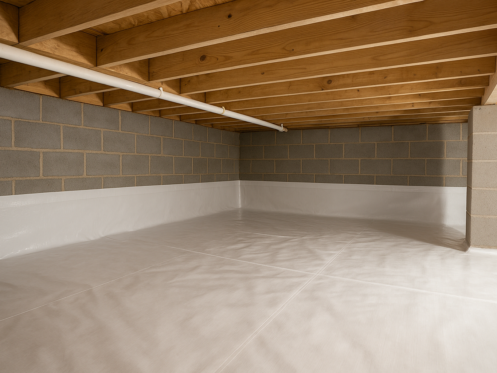
If you’ve ever looked under your house and seen standing water, damp soil, or puddles that never seem to dry out, you already know something’s wrong. What you might not know is that the fix isn’t always encapsulation or a vapor barrier. Sometimes the real issue is that water is getting into your crawl space and has no way out.
That’s where a crawl space drainage system comes in. It’s not glamorous, and it’s not the kind of thing most people think about until there’s a problem. But for a lot of homes across the Carolinas, it’s the difference between a dry crawl space and one that stays wet no matter what else you do.
What a Crawl Space Drainage System Actually Does
A crawl space drainage system is designed to collect water that enters the crawl space and move it out before it causes damage. That’s really it. Water gets in, the system catches it, and a sump pump pushes it away from the house.
Most systems use a perimeter drain, sometimes called a French drain, installed along the interior footer of the foundation walls. The drain collects groundwater and surface water as it seeps in and channels it to a sump pit, where a pump removes it.
Think of it like a gutter system under your house. Your roof gutters catch rainwater and direct it away from the structure. A crawl space drain does the same thing below grade.
Why Water Gets Into Crawl Spaces in the First Place
Homes in North and South Carolina deal with a few specific conditions that make crawl space water intrusion common.
Clay Soil
The Piedmont region, from Charlotte through Concord and Cornelius, sits on heavy clay. Clay doesn’t drain well. After a rain, it holds water and pushes it against your foundation walls and up through the crawl space floor.
High Water Tables
Some areas, especially closer to the coast around Charleston, have naturally high water tables. The ground itself stays saturated, and that moisture migrates upward into the crawl space whether it rains or not.
Poor Exterior Grading
If the soil around your home slopes toward the foundation instead of away from it, rainwater collects at the base of the house and finds its way underneath.
Storm Runoff
In neighborhoods with a lot of hard surfaces like driveways, sidewalks, and patios, rainwater doesn’t absorb into the ground like it should. It runs off and pools near foundations.
None of these are things you can change about where your house sits. But you can manage the water once it gets there.
Interior Drainage vs. Exterior Drainage
Most crawl space drainage systems are installed on the interior. There’s a practical reason for that. Exterior systems require excavating around the entire foundation, which is expensive, disruptive, and sometimes not even possible depending on landscaping, decks, or how close the house is to neighboring structures.
Interior drainage works from the inside. A trench is cut along the perimeter of the crawl space floor, a perforated drain pipe is laid in gravel, and everything channels to a sump pit. The pump does the rest.
Exterior drainage has its place, but for most crawl spaces in the Carolinas, an interior system is the more practical and cost-effective option.
Standing Water Is the Obvious Problem, but Not the Only One
Most homeowners start paying attention to their crawl space when they see standing water. That’s the wake-up call. But water doesn’t have to be visible to cause problems.
Damp soil and high humidity in a crawl space create conditions that lead to a whole chain of issues:
Mold & Mildew
Crawl spaces that stay above 60% relative humidity are prime territory for mold growth. That mold doesn’t stay in the crawl space. Air moves upward through your home in what’s called the stack effect. Whatever is in your crawl space air ends up in your living space.
Wood Rot
Floor joists, subflooring, and support beams in a damp crawl space deteriorate over time. We’ve seen homes across the Charlotte area where the floor feels soft or bouncy upstairs, and the cause is moisture damage to the wood structure below.
Pest Activity
Termites, carpenter ants, and other moisture-loving insects are drawn to damp crawl spaces. A wet crawl space is basically an invitation.
Musty Odors
That smell that won’t go away no matter how many air fresheners you use? It’s probably coming from below the house.
A drainage system addresses the root of all of these problems by removing the water before it creates the conditions that lead to damage.
How Drainage Relates to Encapsulation
Drainage and encapsulation work together, but they solve different problems. Encapsulation seals the crawl space with a heavy-duty vapor barrier to control moisture from the air and the ground surface. Drainage handles liquid water, the kind that flows, pools, and rises from the water table.
Here’s the honest truth: if you encapsulate a crawl space that has active water intrusion without addressing the water first, you’re going to have problems. The vapor barrier will trap the water underneath it, or the water will find its way on top of it, and now you’ve got standing water sitting on your encapsulation.
We see this happen when encapsulation is sold as a one-size-fits-all solution. It’s a great system, but it has to be paired with drainage when water is present. The order matters. Fix the water problem first, then encapsulate.
How Drainage Relates to Dehumidification
Same idea, different issue. A dehumidifier controls humidity in the air. A drainage system removes liquid water. If the crawl space has standing water or active seepage, a dehumidifier alone can’t keep up. It’ll run constantly, struggle to bring humidity down, and burn out faster.
Get the water out first. Then use a dehumidifier to manage the ambient moisture. The two systems complement each other, but neither one replaces the other.
Warning Signs Your Crawl Space Needs Drainage
You don’t always need to crawl under the house to know something’s wrong. Some of the most common indicators are things you notice inside your home:
- Musty or damp smell on the first floor: If it gets worse after rain, there’s moisture below.
- Floors that feel soft, uneven, or bouncy: That could be moisture-damaged subflooring or joists.
- Increased allergy symptoms indoors: Mold spores from a damp crawl space circulate through the whole house.
- Visible mold on first-floor walls or baseboards: Especially along exterior walls.
- High humidity inside the home that your HVAC can’t seem to control: Your system may be fighting a losing battle against crawl space moisture.
- And if you do look under the house:
- Standing water, even small puddles: Water should not be pooling in your crawl space at any time.
- Damp or saturated soil: Even without visible standing water, wet soil means moisture is present and active.
- Water stains on foundation walls or piers: That’s evidence of past water levels.
- Efflorescence on concrete surfaces: White, chalky residue is a mineral deposit left behind when water evaporates from concrete. It means water has been moving through the material.
When Drainage Alone Might Not Be Enough
Drainage solves the water problem. But if the crawl space also has high humidity, no vapor barrier, damaged insulation, or compromised wood, drainage is one piece of a larger solution.
A good contractor will assess the whole crawl space and tell you what combination of systems makes sense for your specific situation. Not every crawl space needs every system. Some need drainage and encapsulation. Some need drainage, a vapor barrier, and a dehumidifier. Some just need a sump pump and better exterior grading.
The point is that there’s no single answer that works for every home. Anyone who tells you otherwise is skipping the assessment.
What To Expect During Installation
Interior crawl space drainage installation is typically a one to two day process. The crew cuts a trench along the perimeter, lays the drain pipe in gravel, installs the sump pit and pump, and backfills. If encapsulation is part of the project, that usually follows once drainage is in place.
It’s not a quiet process, but it’s not a month-long renovation either. Most homeowners are surprised by how quickly it comes together.
Frequently Asked Questions
How much does a crawl space drainage system cost?
It depends on the size of the crawl space, how much water is present, and whether additional systems like a sump pump or vapor barrier are needed. The only way to get an accurate estimate is with an on-site inspection.
Can I install crawl space drainage myself?
It’s possible for minor issues, but a properly installed interior perimeter drain involves cutting concrete or compacted soil, grading the trench correctly, and sizing the sump pump for your water volume. Most homeowners are better off having it done professionally.
How long does a crawl space drainage system last?
A well-installed system with quality materials can function for decades. The sump pump is the component with the shortest lifespan, typically seven to ten years, and should be checked periodically.
Do I need drainage if I already have encapsulation?
If your encapsulated crawl space is staying dry, probably not. But if you’re seeing water pooling on top of or underneath the vapor barrier, drainage should have been part of the original installation.
Will a crawl space drainage system lower my humidity?
It will remove standing water, which is a major humidity contributor. But for optimal humidity control, a drainage system paired with a vapor barrier and dehumidifier is the most effective approach.
Get It Checked Before It Gets Worse
Water in a crawl space doesn’t fix itself. If anything, it gets worse as soil conditions change, drainage deteriorates, and the moisture damage compounds over time. The earlier you address it, the simpler and less expensive the fix tends to be.
RhinoLift offers free crawl space inspections across Charlotte, Cornelius, Concord, Asheville, Cherokee County, and the Charleston area. We’ll tell you what’s going on under your house and whether drainage, encapsulation, or both make sense for your situation.
Schedule a Free Crawl Space Inspection
Reviewed by Josh Kyle Davis, CEO at RhinoLift Foundation Solutions. Licensed General Contractor in NC and SC with 10 years of foundation, crawl space, and structural repair experience.
