
If you live in North Carolina, you already know what humidity feels like. Charlotte summers are sticky. The air around Lake Norman stays heavy well into fall. Down in the Lowcountry, it barely lets up at all.
That same moisture doesn’t stay outside. It finds its way under your house and into your crawl space. Once it’s there, it sticks around, even in November when the weather finally starts to cool down.
A crawl space dehumidifier is one of the most common ways to deal with it. But not every home needs one, and buying the wrong one is a waste of money. Here’s how to tell if yours does, how sizing works, and what it typically costs.
Why North Carolina Crawl Spaces Hold Moisture
Most crawl spaces in the Carolinas sit just a few feet above bare soil. That soil, especially the red clay common across the Piedmont, holds water long after a rain. Moisture rises out of the ground and into the air under your home.
Older crawl spaces were also built with open vents. The idea was to let air flow through and dry things out. In a humid climate, it often does the opposite. Warm, wet summer air drifts in, hits cooler surfaces like ductwork and floor joists, and condenses into water.
So even a crawl space with no standing water can be damp enough to cause problems. That’s where a dehumidifier comes in.
Signs Your Crawl Space Has a Humidity Problem
You don’t have to crawl under the house to spot most signs of crawl space damage. Many show up in your living space first.
- Musty odors: A damp, earthy smell on the first floor is one of the most common signs. Air from your crawl space naturally rises into your home, and it brings that smell with it.
- Condensation: Water droplets on ductwork, pipes, or the underside of the floor mean the air down there is holding more moisture than it can handle.
- Mold or mildew: White, gray, or black growth on floor joists or insulation is a clear sign humidity has been high for a while.
- Sagging or soft floors: Wood that stays damp for years gets weak. If your floors feel bouncy or uneven, moisture may be breaking down the structure underneath.
- High humidity inside your home: If your house feels clammy or your AC runs constantly and never seems to catch up, the source may be below you.
Any one of these is worth a closer look. Two or more usually means it’s time for an inspection.
How a Dehumidifier Works With Encapsulation & Vapor Barriers
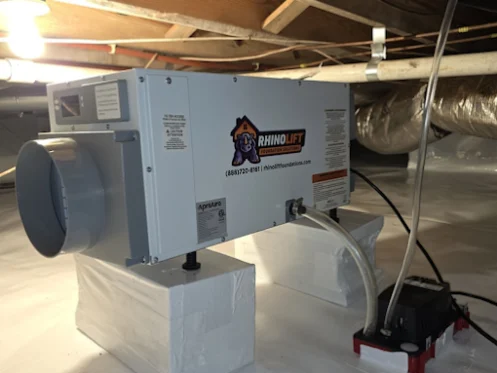
A crawl space dehumidifier pulls moisture out of the air and drains it away, usually to a condensate line or a sump. Most are built to run in tight, low spaces and to handle higher humidity than a basement or household unit.
On its own, though, a dehumidifier is fighting an uphill battle. If your crawl space still has open vents and bare dirt, it’s trying to dry the whole neighborhood’s air. It will run nonstop, and it may never get the space where it needs to be.
That’s why dehumidifiers work best as part of a system:
- A vapor barrier covers the ground and blocks moisture from rising out of the soil.
- Encapsulation seals the walls, vents, and floor so outside air stays out.
- The dehumidifier handles whatever moisture is left in the sealed space.
Think of it this way. The barrier and encapsulation stop new moisture from coming in. The dehumidifier controls what’s already there. If you also have standing water, that needs to be fixed first with proper drainage. A dehumidifier can’t keep up with active water.
Sizing Basics: Bigger Isn’t Always Better
Dehumidifiers are rated by how many pints of water they can remove per day. Crawl space units commonly fall somewhere between 70 and 120+ pints per day.
The right size depends on a few things:
- Square footage of the crawl space
- How well it’s sealed. An encapsulated space needs far less capacity than a vented one.
- Local conditions. A home near the coast or on a wet lot may need more.
An undersized unit runs constantly and wears out early. An oversized one costs more upfront and can cycle on and off too often. The goal is to keep relative humidity steady, generally below 60%, which is the range where mold struggles to grow.
This is one reason a professional assessment matters. Measuring moisture levels and checking how sealed the space is gives you the right size, not a guess.
What Does a Crawl Space Dehumidifier Cost?
Costs vary quite a bit from home to home. As a general range, many professionally installed crawl space dehumidifiers land somewhere between $1,500 and $3,000. Larger spaces, higher-capacity units, or more complex drainage setups can push that higher.
What affects the price:
- The size and capacity of the unit
- Whether drainage needs to be added for the condensate
- Electrical work, if there’s no outlet nearby
- Whether it’s part of a larger encapsulation project
If you’re considering encapsulation too, it often makes sense to plan both at once. Our Crawl Space Encapsulation Cost guide breaks down what goes into a full project.
The only way to get an accurate number for your home is an on-site inspection. We’ll give you clear, upfront pricing before any work begins.
When You Might Not Need One
Not every crawl space needs a dehumidifier. If your space is already dry, your humidity readings are in a healthy range, and you’re not seeing any of the warning signs, you may be fine as-is.
We’d rather tell you that than sell you something you don’t need. That’s how we work.
Frequently Asked Questions
What humidity level should my crawl space be?
Most crawl spaces should stay below 60% relative humidity. Above that, mold and wood rot become much more likely.
Can I use a regular dehumidifier in my crawl space?
Household units aren’t built for crawl spaces. They’re often too small, can’t handle the low temperatures and high moisture, and usually need to be emptied by hand. Crawl space units are designed to drain automatically and run in tight spaces.
Do I need a dehumidifier if my crawl space is encapsulated?
In most North Carolina homes, yes. Encapsulation keeps new moisture out, but a dehumidifier controls the humidity that remains inside the sealed space.
How long does a crawl space dehumidifier last?
With regular maintenance, like cleaning or replacing filters, many units last several years. Lifespan depends on the model, how hard it has to work, and how well the space is sealed.
Will a dehumidifier get rid of the musty smell in my house?
It often helps, since the smell usually comes from damp air rising from the crawl space. If mold is already present, it may need to be addressed separately.
Find Out What’s Going On Under Your Home
If you’re noticing musty smells, condensation, or floors that don’t feel right, your crawl space may be holding more moisture than it should. RhinoLift offers free crawl space inspections across Charlotte, Cornelius, Concord, Asheville, Charleston, and the surrounding areas. We’ll measure humidity, check for moisture sources, and give you honest recommendations.
Schedule a Free Crawl Space Inspection.
Reviewed by Josh Kyle Davis, CEO at RhinoLift Foundation Solutions. Licensed General Contractor in NC and SC with 10 years of foundation, crawl space, and structural repair experience.
